Hirsutism Part 1

The Ferriman-Gallwey score is a method of evaluating and quantifying hirsutism in women. The method was originally published in 1961 by D. Ferriman and J.D. Gallwey in the Journal of Clinical Endocrinology. [1] The original method used 11 body areas to assess hair growth, but was decreased to 9 body areas in the modified method: In the.
Ferriman and Gallwey Score PDF

The women with hirsutism have been assessed on the chin according to Ferriman-Gallwey score, where score 0 (complete lack of terminal hairs) was present in 16.3% of women with hirsutism, score 1 (minimal presence of terminal hairs) in 9.6%, score 2 (more than minimal terminal hairs) in 13.3%, score 3 (not too large hairs) in 40.7% and score 4.
FerrimanGallwey scores and basal hair diameters (mm) in patients with... Download Table

Professor of Medicine Section of Endocrinology, Diabetes, and Metabolism The University of Chicago Chicago, IL. Term. Definition. Hirsutism. Excessive terminal hair that appears in a male pattern (excessive hair in androgen-dependent areas, ie sexual hair) in women. Modified Ferriman-Gallwey Score. The gold standard for evaluating hirsutism.
Hirsutism scoring system of Ferriman and Gallwey. The nine body areas... Download Scientific

Hirsutism is a clinical diagnosis, and prevalence depends on the diagnostic criteria used. Hirsutism is commonly diagnosed using the modified Ferriman-Gallwey scoring system consisting of nine.
Hirsutism scoring system of Ferriman and Gallwey. The nine body areas... Download Scientific

This score of ≥8 was put forward by Hatch et al., although Ferriman and Gallwey themselves have used different cutoffs in different studies.[2,3,4,5,6] As ethnicity and race can affect the terminal hair growth, the ideal cutoff value should be the 95 th percentile value of the score of unselected women of reproductive age. A specific.
FerrimanGallwey images 39 used for participant selection. Download Scientific Diagram

Comité de rédaction; Condensation et indexation; Access Subscribe; Activate Online Access; Abonnement S'abonner; Devenez membre External Link. The modified Ferriman-Gallwey score can be used in the assessment of hirsutism to help quantify the problem and assess the response to treatment. Cut-off scores defining hirsutism will vary by.
Hirsutisme Score De Ferriman Et Gallwey Dr KARAZAITRI M.A

To determine whether assessing the extent of terminal hair growth in a subset of the traditional 9 areas included in the modified Ferriman-Gallwey (mFG) score can serve as a simpler predictor of total body hirsutism when compared to the full scoring system, and to determine if this new model can accurately distinguish hirsute from non-hirsute.
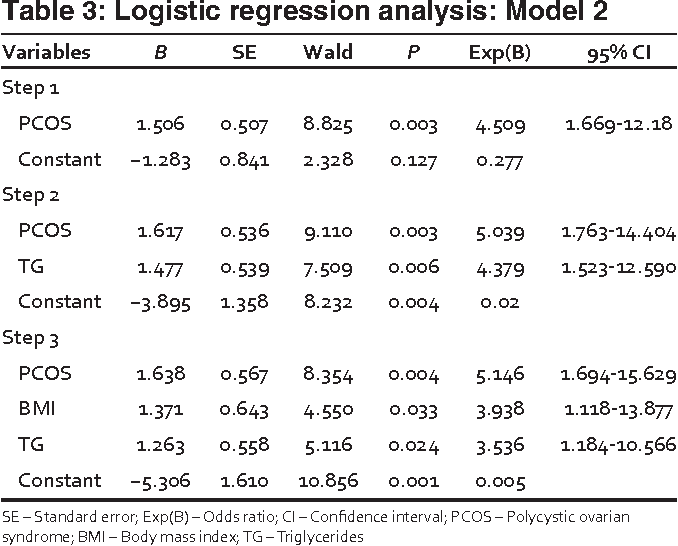
Table 3 from Modified FerrimanGallwey Score in Hirsutism and its Association with Metabolic
In 1961, Ferriman and Gallwey developed the most widely used system for describing hirsutism, the Ferriman-Gallwey (FG) score. The original FG score assessed 11 body sites. It was later limited (modified FG, or mFG, Fig. 1) to 9 sites, with a score of 8 or more being considered abnormal, and is the version widely used today.
Modified FerrimanGallwey scoring for grading hirsutism Download Scientific Diagram

The total score was calculated, and an mFG score of ≥ 8 was accepted as hirsutism [ 1, 5 ]. The severity of hirsutism was classified as mild if the mFG score was 8-16, moderate if 17-24, and severe if above 24 [ 1 ]. The details of the mFG scores and age were retrospectively obtained from the files of the patients.
The overall scoring by FerrimanGallwey score Download Table

The gold standard for diagnosing hirsutism is based on the modified Ferriman-Gallway (mFG) score, requiring trained and in-person evaluation. Our study aimed to evaluate whether using mobile phone images of the nine mFG areas could offer an alternative way to support the diagnostic of hirsutism. All patients from an endocrine outpatient clinic underwent an initial mFG evaluation by two blinded.
(PDF) Grading of hirsutism a practical approach to the modified FerrimanGallwey scoring system

In 1961, Ferriman and Gallwey described a scoring system to determine the degree of hirsutism. scored the density of terminal hairs at 11 different body sites (i.e., upper lip, chin, chest, upper back, lower back, upper abdomen, lower abdomen, arm, forearm, thigh, and lower leg). for each of these areas, a score of 0 (absence of terminal hairs.
HIRSUTISME Escala de Ferriman i Gallweydermatologia.cat/wpcontent/uploads/2018/03/Hirsutisme

Objective: To study Ferriman-Gallwey (FG) scoring in adolescents with an aim to correlate these scores with serum androgens and mullerian inhibiting substance (MIS). Design: Cross sectional study. Setting: Pediatric and Adolescent Gynecology Clinic of a university hospital. Patients: Twenty-four hirsute adolescent girls age 12-19 with a FG score of 6 or greater.
Simplified FerrimanGallwey (sFG) score of different body areas among... Download Scientific

Approximately half of women with mild hirsutism (i.e., hirsutism with a score of 8 to 15, out of a maximum of 36, on the Ferriman-Gallwey scale) have the idiopathic condition, 6 whereas in the.
Severe hirsutism (FerrimanGallwey score of 32) and acanthosis... Download Scientific Diagram

The Ferriman-Gallwey score is a method of evaluating and quantifying hirsutism in women. The method was originally published in 1961 by D. Ferriman and J.D. Gallwey in the Journal of Clinical Endocrinology. The original method used 11 body areas to assess hair growth, but was decreased to 9 body areas in the modified method: In the modified.
PPT SÍNDROME DE OVARIO POLIQUÍSTICO PowerPoint Presentation, free download ID906300
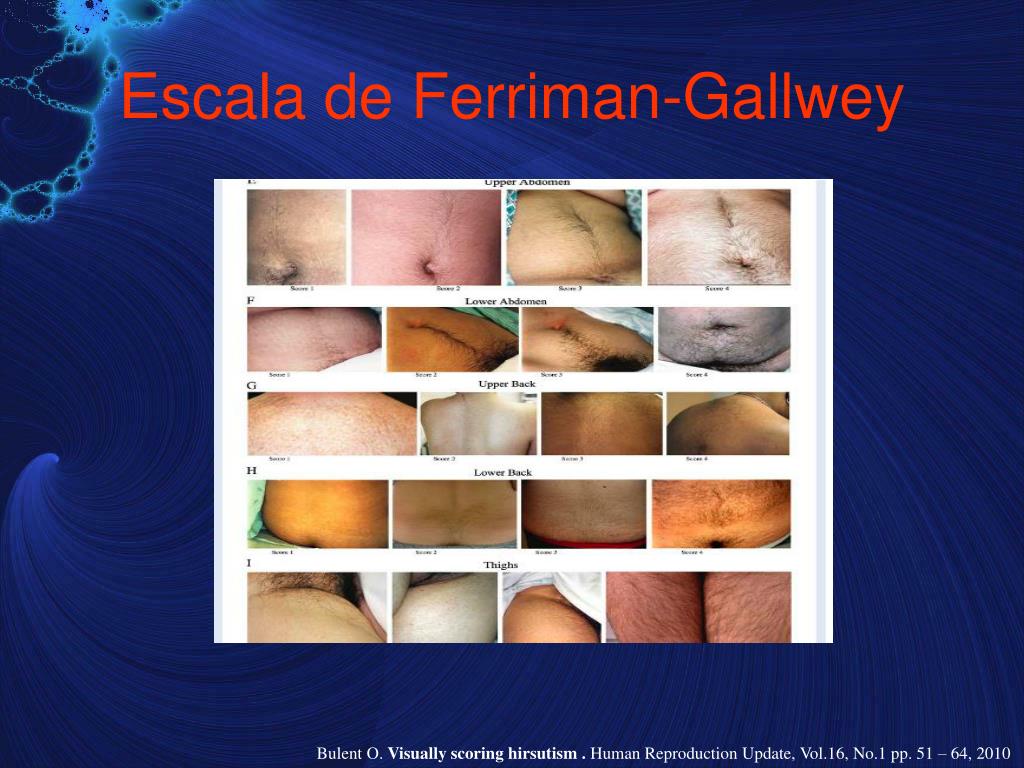
Introduction. Hirsutism is the presence of excess body or facial terminal (coarse) hair growth in females in a male-like pattern, and affects 5-15% of women depending on definition (Danforth and Trotter, 1922; Beek, 1950; Shah, 1957; Ferriman and Gallwey, 1961; McKnight, 1964; Moncada-Lorenzo, 1970; Lunde, 1984; Lunde and Grottum, 1984; Derksen et al., 1993; Simpson and Barth, 1997.
Ferriman and Gallwey scoring system (each zone is scored 04 (max 44)).... Download Scientific

The modified Ferriman Gallwey score (m FG) is a common visual scale. It assesses terminalization of hair in the nine androgen-sensitive areas: lip, chin, chest, back, upper arms, lower abdomen, and upper thighs. The nine areas are graded between 0 (no terminal hair) to 4 (excess terminal hair), with hirsutism defined by a score of 8 or more.
.